The U.S. military operates an extensive fleet of tactical trucks, each designed to support missions in the field.
When a unit deploys—whether it’s an armored division, mechanized infantry, or a combat aviation brigade—everything moves with them: personnel, fuel, munitions, tools, spare parts, and more.
But what happens when one of those vehicles gets stuck? Or when a tank, armored personnel carrier, or other tactical vehicle is damaged but not destroyed?
That’s where recovery vehicles come in.
Recovery vehicles are purpose-built to retrieve disabled or immobilized military equipment from the battlefield. Whether it’s towing a downed vehicle, performing on-the-spot repairs, or navigating rough terrain to reach stranded units, these machines are the unsung heroes of military logistics.
Once these vehicles complete their service, some are released for surplus sale. That means you might actually be able to own one.
So, what exactly is a recovery vehicle—and how can you get your hands on one?
Recovery vehicles are purpose-built to retrieve stranded trucks, tanks, armored vehicles, and just about anything else that gets stuck in mud, sand, or difficult terrain—or ends up damaged in combat. (To be clear, fully destroyed vehicles typically aren’t recovered—there’s not much left to salvage.)
Consider this: the M1 Abrams main battle tank weighs anywhere from 60 to 74 short tons, depending on the variant. That’s the kind of weight a recovery vehicle needs to handle—out in the middle of nowhere, in the worst terrain imaginable.
These machines aren’t just built to survive the mission. They’re built to haul a crippled tank onto a trailer, maneuver it out of hostile terrain, and deliver it to a depot for repairs—often under intense conditions and without backup.
What Are They Recovering?
Everything. If it went out into the field, it goes back to the garrison for repair and accountability.
When it comes to military recovery, everything gets pulled out—every tank, every truck, every MRAP. If it can be moved, it will be recovered.
So, how does the military retrieve vehicles in various states of disrepair?
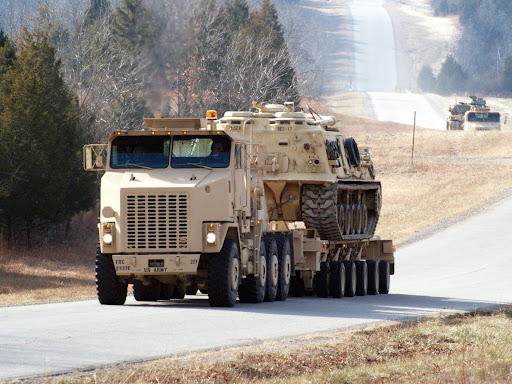
For starters, tactical recovery trucks are equipped with multiple heavy-duty, rear-facing winches—some with staggering pulling power. Take the Oshkosh M1070, for example. This beast comes standard with two 55,000-pound winches, built specifically to haul immobilized vehicles onto trailers.
Originally designed to transport the M1 Abrams main battle tank using the M1000 trailer, the M1070 doesn’t stop there. Its capabilities extend well beyond tanks—it’s been used to recover all types of military vehicles in some of the world’s toughest environments.
The M1070 is an 8×8 truck, featuring eight single tires (one per side, per axle) instead of the usual configuration of front singles and rear duals. Exact towing ratings vary, but the M1070 is engineered to exceed 70 tons—because the most recent version of the M1 Abrams weighs in at nearly 75 tons.
Because of its extreme capability, the M1070 has found new life in the civilian world. Heavy-wrecking and off-road recovery companies have picked up surplus M1070s for jobs where commercial equipment simply won’t cut it.
The logging industry uses them to access remote forests, and even rural utility companies—like one electrical co-op near my hometown—rely on them to haul heavy spools of wire and gear into hard-to-reach job sites.
Where Can I Buy One?
If you’ve spent any time browsing Marketplace or Craigslist, you’ve probably come across a bunch of used M35s, M939s, and LMTVs.
That’s no coincidence—these trucks are some of the most widely used in the U.S. military’s inventory, which means they’re also the most likely to end up on the surplus market.
Thanks to their abundance, they’re usually available at relatively low prices, making them an affordable entry point into the world of military-grade vehicles.
The best place to look is GovPlanet since they hold a contract with the DLA to auction off surplus equipment. Now, this service is not vehicle-specific. GovPlanet auctions anything and everything you can think of.
There has yet to be a schedule for what goes live and when, and because GovPlanet is an auction platform, there is no set price, although once you make an account, you can see what past lots have sold for to get an idea of what you could expect to pay in the future.
What Models Are Available?
Most of the time, the basic cargo models of the trucks are the easiest to find because they were used in the army more than anything else. Specialty trucks like wreckers, refuelers, and box van trucks are harder to come by, but possible.
If you’re out here buying a surplus military vehicle for off-road recovery, I bet bolting some winches and a flatbed onto a cargo truck to make it a wrecker won’t be a problem for you.
It works like this: tactical vehicles are kept on a central ledger and issued to units based on a standardized table distribution of allowances (TDA).
So, when the same central planning agency within the army (or whatever branch of service) sees that they have been in service for their obligated period of time, they are pulled and culled from the inventory. This happens regardless of the number of miles, how well the individual machine operates, etc.
The guys ordering these trucks have probably never even seen a wrench, let alone turn one. They are professional bean counters.
They send out the operational order; individual units must comply.
Just about anything that rolls through the motor pool is eventually going to end up in one of three or four places:
- Foreign military
- Civilian agency use (Forest Service, Fire Departments, Police Departments, etc.)
- Civilian surplus
What this usually looks like, though, are support vehicles for Patriot missiles or HIMARS packages with all of the weapon-specific stuff removed.
Can Civilians Own One?
Absolutely. A common wrecker or cargo truck is generally fine as-is, and anything that had been used as a weapon platform is fully demilitarized before it is auctioned, so anything sensitive has been removed.
If it cannot be removed for structural reasons (i.e., a tank turret with a cannon), a plug is welded on the barrel, and sometimes the breach is destroyed. Of course, you might want to do a little more than that before you start answering customer calls at your off-road recovery job. Or maybe not.
But beyond this, there are few restrictions to owning military surplus. Once it hits GovPlanet, it’s good to go for you to buy. For example, there are about ten MTV 6×6 trucks on the site, ready to buy at the time of writing this article.
There are no guarantees about any particular make or model, and it is an auction, so be ready to fight for it if you want something that’s on there.
How It Works
Got the truck? Perfect—now let’s get it street-ready.
With Dirt Legal’s Military Vehicle Program, the hard part’s already done. Just choose the package that fits your build, click a few buttons, and we’ll handle the rest. Once you return the signed paperwork using the prepaid envelope we send, you’re on your way.
Yep, it’s really that simple. And depending on where you live, you might even be able to drive it locally.
Here’s how it works: When your vehicle is titled and tagged under a Montana LLC, it’s officially owned by that LLC—not by you personally in California, Colorado, or wherever home is.
That small detail makes a big difference. It’s what allows us to help you put military recovery vehicles on the road—and keep them there.